Borough Punching Above its Weight in Economic Development
But not everyone believes that residents are seeing the full benefits
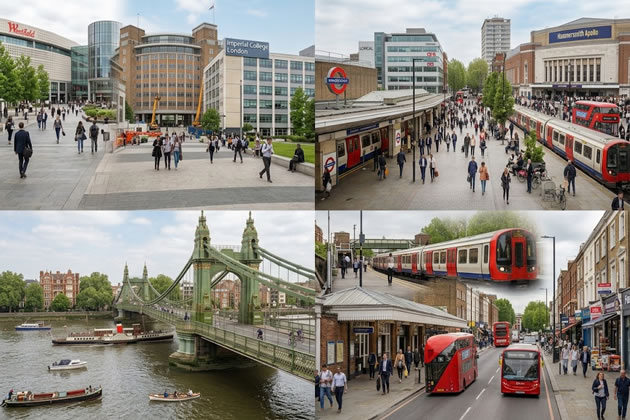
Three of London's strategic economic clusters are in the borough. Picture: AI Generated
August 10, 2026
By the standard of most London boroughs, Hammersmith and Fulham is small.
Wedged between Kensington and Chelsea to its east and Ealing and Hounslow to its west, it looks on a map as if it is being crushed by its neighbours, tall and somewhat thin as the air is slowly squeezed out of it.
Its Inner London location bestows it with a number of advantages, and the borough’s two Premier League football clubs (Chelsea and Fulham), plus Championship side Queen’s Park Rangers, give it sporting credentials few others in the capital can claim.
There is however something else going on in this part of West London.
In Sir Sadiq Khan’s recently-published draft London Plan he lists 18 ‘strategic economic clusters’.
According to the draft plan, these are areas designated for economic growth not included in existing corridors, such as town centres or Central Activities Zones (CAZ).
Of the 18 clusters identified three are either fully or partly in Hammersmith and Fulham, a feat only matched by Hounslow.
The three listed are: Earl’s Court, a site split with Kensington and Chelsea and due to welcome the construction of a 4,000-home neighbourhood; Olympia, which is home to a new £1.3 billion redevelopment of the former exhibition centre; and White City, which has become a hub for health and life sciences and media.
While none of these schemes are news to anyone living in the borough, nor are they universally backed, their prominence in the Mayor’s plans appear to reflect a recognition of the economic potential of this small corner of the capital.
As has been pointed out by the local authority, this is partly already being realised, with Hammersmith and Fulham London’s fastest growing economy and in the top 10 UK-wide according to the Office of National Statistics.
The council also claims to have attracted more than £6 billion in investment in “high-growth sectors” and curated 17,200 new jobs, driven by its flagship economic strategy Upstream London.
Hammersmith and Fulham Council’s approach to its local economy came in for particular praise by the developers behind the Earl’s Court scheme.
Split across a 40 acre patch of land formerly home to the Earl’s Court Exhibition Centre, the site is divided between Hammersmith and Fulham and neighbouring Kensington and Chelsea.
It has sat largely unused since the buildings were demolished between 2015 and 2017.
The proposal, which was approved by Hammersmith and Fulham Council last November and Kensington and Chelsea the month after, will see a new neighbourhood developed, with shops, restaurants and bars as well as the homes.
The Earl’s Court Development Company (ECDC),a joint venture between Delancey, APG and Places for London, Transport for London ’s (TfL) property arm, says once complete the scheme will deliver £3bn annually to the UK economy and 23,500 jobs across the UK.
Work is expected to begin on-site in 2028, with the development to be delivered in phases over a 15 to 20 year period.
Asked whether there is anything specific to Hammersmith and Fulham that makes the borough attractive for investment, an ECDC spokesperson said: “There is a very clear focus on inclusive growth and growing the economy, for the benefit of the borough as a whole, which is followed rigorously.
“Hammersmith and Fulham is unusual as a local authority in having very defined policy on economic growth and inward investment.
“Embodied in their Upstream London Industrial Strategy, the borough benefits from a leadership which recognises the importance of partnership to generate returns for the whole of the borough.
“The role of strong leadership in creating an environment which not only welcomes investment but works with public, private and education sectors to support that investment into the borough, broker partnerships and provide backing should not be under-estimated.
“This then brings huge benefits to the borough as a whole across skills, education, training, opportunity, investment, economic and social impact.”
Another of the projects referenced in the Mayor’s draft Plan, the Olympia, has already started opening.
Previously occupied by the famous exhibition centre, it is being redeveloped to deliver cultural amenities from theatres to music venues to a drama school and hotels, plus a significant amount of workspace.
According to data provided by the team, Olympia’s redevelopment is expected to drive over £600m to the UK economy annually and attract 3.5m visitors a year.
On the appeal of Hammersmith and Fulham, a spokesperson said: “Olympia is a good example of how investment can restore a historic landmark while creating jobs, new cultural venues and wider economic benefits for the local area. It brings a new place for the local community to eat, drink, discover on their doorstep, in this pocket of West London.”
The developments have not been backed in all quarters, with concerns ranging from the impacts on transport to the tangible benefits for local residents.
The White City Residents Association (WCRA), which represents the estate in the north of the borough, said the nearby Innovation District has yet to prove its worth to locals.
The district is a collaboration between the council and Imperial College London established in 2017, and is home to companies operating in sectors from AI to life sciences.
A spokesperson for the WCRA said: “Reflecting on the White City Opportunity Area and Innovation District, WCRA noted that, while there have been some links specifically for residents through Imperial College and the WEST youth centre, in terms of its overall connection to and benefits for White City residents, the White City Innovation District might as well have been located in Fulham.
“Being part of the Opportunity Area and next to the Innovation District has brought noise, dust and substantial disruption over many years for residents of both White City and Wood Lane estates as huge developments have gone up around the area, but there have been few gains for those who live here.”
They added the WCRA and other associations have had to push for stakeholder meetings involving the council and developers to hear about building plans, but these have not always been forthcoming.
“Early offers of opportunities for local people from developers and site operators have not been delivered and WCRA is not aware of dedicated routes for local people to access training or job opportunities.
“Indeed, WCRA is aware that local people have been frustrated in seeking opportunities with the organisations and businesses brought in as part of the White City Innovation District and Opportunity Area – and if there are routes to employment and training, they have not been actively shared with residents or their representative associations.
“The Innovation District may have delivered for the council, its organisational partners and commercial interests but it has been a missed opportunity for White City residents.”
A council spokesperson said its Hammersmith and Fulham Pathway Bond, which has been backed by more than 100 local businesses, “is connecting our young people to these jobs of the future.
“So, no matter their background, they can access opportunities and life skills in the industries of the future.”
The spokesperson continued: “At the heart of White City sits our £150m EdCity development, offering people of all ages the very best in education, training and play. It hosts a new Hammersmith and Fulham Adult Learning and Skills Centre, new state-of-the-art primary school and the stunning WEST Youth Zone.
“WEST is one of Europe’s most impressive youth centres, offering a four-court sports hall, climbing wall, music and dance studios and much more, all for just £5 annual membership and 50p per visit – as well as work-based programmes connecting young people directly with businesses in the innovation district.”
The spokesperson added the world is changing at-pace due to new technologies and AI.
“But in Hammersmith and Fulham we aim to help shape that future, not cower from it, by rising to the enormous challenges and giving our young people the very best opportunities in life.”
A spokesperson for the Mayor of London said: “The draft London Plan creates a clear, long-term roadmap for businesses to invest in London with confidence. It focuses growth on four key ‘super sectors’: financial and professional services, creative industries, the experience economy, and frontier innovations like life sciences, tech, and AI.
“Central to this vision are new Strategic Economic Clusters, which act as local job hotspots outside central London designed specifically to help these industries thrive. The Plan protects the land businesses need, safeguards affordable workspaces for start-ups, and will help to deliver the vital infrastructure – from data centres and digital connectivity to energy and logistics networks – that underpins a modern economy.”
Ben Lynch - Local Democracy Reporter