Ranelagh Gardens Arches To Be Transformed
Changes to neglected area on Thames Path by Putney Bridge approved
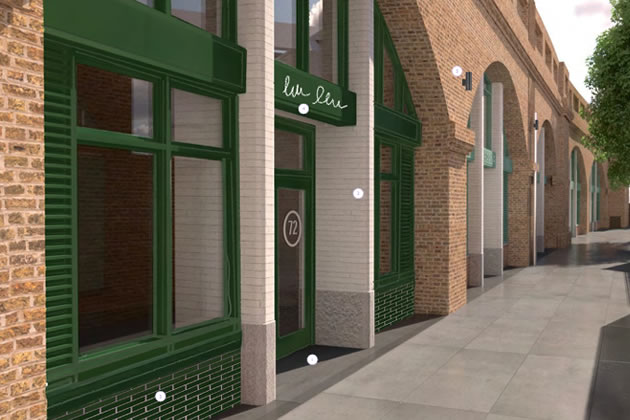
A visualisation of how the arches might look after the makeover. Picture: Places for London
August 3, 2026
A long-neglected stretch of the Thames Path at Putney Bridge is set for a significant revival, as Places for London—Transport for London’s property company—moves forward with plans to refurbish and reopen five vacant railway arches at Ranelagh Gardens. The scheme, recently recommended for approval by Hammersmith & Fulham Council, promises to reshape the public realm, improve safety, and bring new commercial life to a historic but underused corner of Fulham.
The arches—numbered 72 to 76—sit beneath the District line platforms at Putney Bridge Station, flanked by the Thames Path to the west and a narrow service yard to the east. All five units have been vacant for several years, and the surrounding spaces have suffered from poor lighting, obstructed sightlines, and persistent antisocial behaviour which led to complaints about this area being unsafe at night.
The most visible change will be the complete redesign of the arch frontages along the Thames Path. The current blank façades, mismatched infills, and utility cabinets will be replaced with unified, high-quality shopfront-style elevations inspired by local conservation area guidance. The proposal draws directly from nearby architecture, including the glazed brick stall risers and dark green joinery seen at Ranelagh Gardens Mansions and the River Café. The application states that the new design “aims to reinforce the visual identity of Ranelagh Gardens Mansions and road arch,” using off‑white and heritage green glazed brick to create a robust, attractive frontage.
Entrances will be recessed to improve accessibility and avoid obstructing the path. The documents specify that “the facade has been set back by 300 mm… [and] the primary access door for each arch has also been further set back… by 1000 mm,” making it easier to progress along the walkway.
One of the most transformative interventions is the removal of the boundary wall and lean‑to structures outside Arches 75 and 76. These currently block views and narrow the Thames Path at a key junction. Their demolition will “widen pedestrian area, and greatly expand the public realm sight lines to improve access and visibility.” The widened path will be resurfaced in resin‑bound gravel, colour‑matched to existing paving but textured to distinguish Places for London land.
A mature tree—partially enclosed by the existing lean‑to—will be carefully retained with a repaired or replaced brick planter ensuring long-term protection of the root structure.
Safety is a central theme throughout the proposal. The Thames Path and the enclosed passage beneath Arch 74 will receive new low-spill lighting mounted directly to the viaduct structure. The aim is to improve visibility without disturbing nearby homes. The approach is described as “indirect low-spill uplighting… and location-altered path low-spill downlight columns,” with heritage lighting restored rather than replaced.
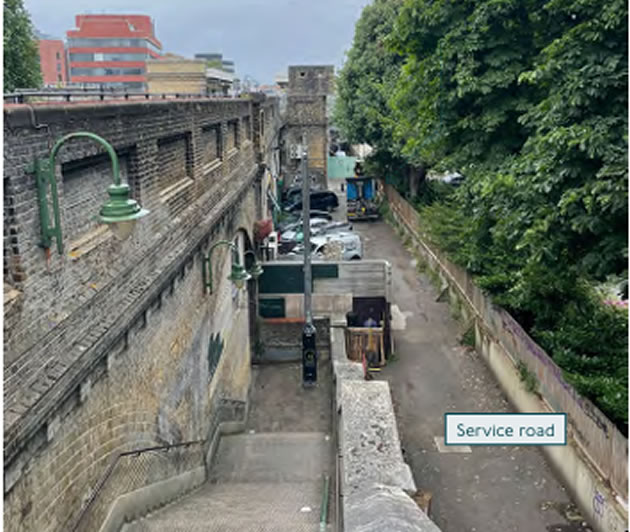
The area around the arches as it is now
Wayfinding will also be upgraded, using discreet signage fixed to existing structures and potential floor inset markers. Key junctions—such as the three-way fork outside Arch 74—will be highlighted to improve legibility for pedestrians navigating between the Thames Path, Putney Bridge Station, and the river crossing.
The Thames Path in this location is currently uneven, cluttered with downpipes and service cupboards, and difficult for visually impaired users to navigate. The new scheme proposes relocating or visually contrasting street furniture, levelling internal floors, and ensuring step-free access to all units. The application notes that “our new arch facades… have recessed entrance doors meaning that there is no unexpected intrusion into the Thames Path pedestrian walking area.”
Behind the arches, the service yard will be resurfaced, fenced with visually permeable Lang & Fulton mesh, and planted with soft landscaping to reduce noise and improve air quality. The yard will continue to function as a secure servicing area, with time-restricted access for small delivery vehicles. Ten covered long-stay cycle spaces for staff and ten short-stay visitor spaces will be installed, including five along the Thames Path.
Refuse storage will be consolidated along the brick wall of the service yard, providing each tenant with one general waste and one recycling eurobin.
The arches sit within the Putney Bridge Conservation Area and adjacent to Hurlingham Conservation Area. The proposal is careful to respect this context, drawing on local materials and proportions while restoring historic brickwork.
The scheme also acknowledges the site’s deeper history. Arch 72 was once home to the workshop of Frederick Simms, “Father of the British Motor Industry,” and still sits beneath a Second World War defensive pillbox. The applicant intends to reinstate a public marker to commemorate Simms’ contribution.
The council’s planning report recommended approval subject to a legal agreement and a comprehensive set of conditions. These include strict controls on operational hours, noise, lighting, deliveries, odour extraction, and external amplified sound—reflecting the proximity of residential neighbours. Conditions also require installation of air-source heat pumps, electric vehicle charging points, cargo bike parking, and a detailed Ultra Low Emission Strategy. This recommendation was unanimously accepted by councillors at a borough planning committee meeting.
Taken together, the proposals represent a substantial investment in a neglected but strategically important riverside location. By activating the arches with new commercial uses, improving safety and accessibility, and opening up views along the Thames Path, the scheme aims to transform the area into a welcoming, lively, and better-connected part of Fulham.
If delivered as planned, the Ranelagh Gardens Arches could become a model for how London’s railway infrastructure can be sensitively adapted to support local communities, heritage, and public realm.
Like Reading Articles Like This? Help Us Produce More This site remains committed to providing local community news and public interest journalism. Articles such as the one above are integral to what we do. We aim to feature as much as possible on local societies, charities based in the area, fundraising efforts by residents, community-based initiatives and even helping people find missing pets. We’ve always done that and won’t be changing, in fact we’d like to do more. However, the readership that these stories generates is often below that needed to cover the cost of producing them. Our financial resources are limited and the local media environment is intensely competitive so there is a constraint on what we can do. We are therefore asking our readers to consider offering financial support to these efforts. Any money given will help support community and public interest news and the expansion of our coverage in this area. A suggested monthly payment is £8 but we would be grateful for any amount for instance if you think this site offers the equivalent value of a subscription to a daily printed newspaper you may wish to consider £20 per month. If neither of these amounts is suitable for you then contact info@neighbournet.com and we can set up an alternative. All payments are made through a secure web site. One-off donations are also appreciated. Choose The Amount You Wish To Contribute. If you do support us in this way we’d be interested to hear what kind of articles you would like to see more of on the site – send your suggestions to the editor. For businesses we offer the chance to be a corporate sponsor of community content on the site. For £30 plus VAT per month you will be the designated sponsor of at least one article a month with your logo appearing if supplied. If there is a specific community group or initiative you’d like to support we can make sure your sponsorship is featured on related content for a one off payment of £50 plus VAT. All payments are made through a secure web site. |