'Rotten' Hammersmith Bridge at Risk of Total Closure
Council meeting told that it needs rebuilding piece by piece
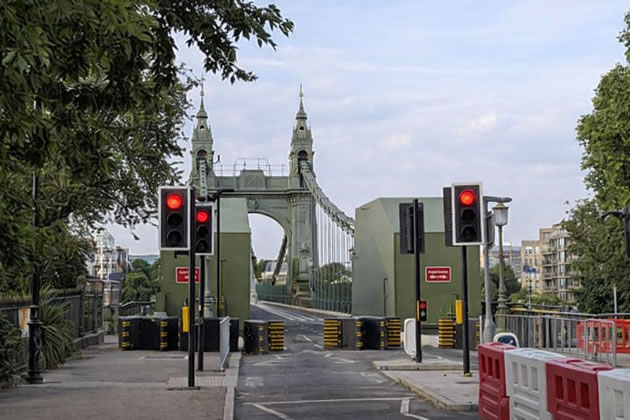
Hammersmith and Fulham Council to proceed with bid to Structures Fund. Picture: Facebook
July 12, 2026
Hammersmith and Fulham Council's cabinet has formally endorsed plans to submit a bid to the government's Structures Fund, taking a significant step in the long-running saga over the future of the 139-year-old Grade II* listed bridge. The decision, rubber-stamped at a meeting on Monday 6 July, sets the borough on course to apply for £128 million to fund the most urgent repair works.
The scale of the challenge facing the bridge was laid bare at the meeting, where it emerged that the project under consideration amounts to a complete rebuild rather than a simple repair. Council leader Steven Cowan did not mince words, describing the bridge's condition in stark terms: every part of the structure, he said, is rotten and in need of restoration or replacement — which is why the bill for a full heritage fix runs to some £300 million.
The £128 million now being sought is intended to cover the most at-risk components requiring urgent attention, including the long-awaited restoration of the seized-up pedestal casings that have sat in storage since the bridge's 2025 stabilisation works. Crucially, the council's own report cautions that this figure should not be seen as final — further critical issues are expected to surface as work progresses.
Were this work not to be carried out the council is warning that the bridge would quickly be in a condition that it was no long safe for pedestrians and cyclists to use and the passage of river traffic underneath it might also be affected. Since reopening to pedestrians and cyclists in April 2025 — following stabilisation work on cast-iron pedestals found to have developed dangerous micro-fractures — the bridge has remained officially classified as "substandard".
The scope of the bid, which will not restore access for motor vehicles, was shaped largely by the Department for Transport's own deadline: any Structures Fund-backed project must be fully delivered by 31 March 2030, a constraint that ruled out pursuing the full restoration in one go. Notably, officials confirmed that most of the structural work required would be identical whether or not the bridge is ultimately reopened to motor traffic — meaning the extra cost of a full reopening, on top of the baseline restoration, would be roughly £50 million.
The council also revealed that the DfT itself had advised it last year to put together this more limited, phased bid.
Alongside the Structures Fund bid, the cabinet also approved a separate, smaller allocation of £1.5 million: the bare minimum needed to meet the council's statutory safety obligations under the Highways Act 1980. Even this baseline maintenance comes with a price tag attached — roughly £1.5 million a year in inspections and monitoring from 2026/27, plus around £500,000 annually in other unavoidable costs, including storing the removed pedestal casings. The council has been blunt that this minimum spend will not be enough to guarantee the bridge stays open to pedestrians and cyclists, and has not ruled out a complete closure.
Not everyone at Monday's meeting welcomed the plan. Richmond Council's deputy leader, Alex Ehmann, delivered a pointed critique, arguing that scaling back from a fuller restoration — one that could eventually restore bus and emergency service access — represented a lack of ambition after years of disruption. He argued that the needs of residents unable to walk or cycle across the river were being overlooked, and pledged that Richmond would keep pushing for what he called a "Better Bridge."
His comments echo a broader frustration from Transport for London, which has consistently argued that restoring the bridge's bus routes — six services were affected by the closure — should be a priority. Data suggests that, before closure, more people crossed the bridge by bus than by any other means, including on foot. Replacement bus services introduced since have not seen anything like a comparable rise in usage.
Engineers involved in the restoration believe the bridge's own history of closure is partly responsible for its deterioration. When motor traffic was banned in April 2019, the constant vibration from decades of buses and lorries crossing the structure came to an abrupt halt. That movement, it turns out, had been keeping the 19th-century ironwork's bearings from seizing. Once it stopped, corrosion and thermal stress built up unchecked inside the cast-iron pedestal casings, eventually producing the micro-fractures discovered in 2020 that forced the bridge's full closure, even to walkers. Although the point is disputed, it is contended by some that heavy vehicles crossing are a requirement to keep the bearings in a state that protects the integrity of the bridge.
The question of funding responsibility remains a live sticking point between the three main parties involved. Hammersmith & Fulham Council says it is still owed £22.9 million in total from earlier stabilisation works — £16.51 million from TfL and £6.42 million from the DfT — money it argues would be needed for the bridge's costs to be split evenly three ways.
TfL, for its part, maintains it only ever committed a maximum of £2.93 million towards the stabilisation works and takes no responsibility for cost overruns. A TfL spokesperson said the organisation continues working with the council, the DfT, and other partners to agree both a solution and a funding arrangement for future works.
The DfT, meanwhile, points to the £17 million it has already provided to keep the bridge open to walkers and cyclists, and says it will keep working with the council and TfL as it considers further funding through the new Structures Fund.
Whether a successful Structures Fund bid would go any way toward settling the council's outstanding claims remains unclear.
Monday also saw the arrival in Barnes of two self-driving electric shuttles, brought in on a low-loader from Milton Keynes, where similar vehicles already operate on public roads. The shuttles are being championed by Barnes & Hammersmith Electric Light Transit (BHELT), a community interest company chaired by local resident Charles Campion.
Campion argued that with a full reopening to traffic clearly off the table for the foreseeable future, a "radical solution" was needed — one that could restore mobility access lost when buses stopped crossing the bridge. He said BHELT wants to engage with local councils, TfL, and national government to ensure driverless pods are factored into the bridge's strengthening plans. The idea has drawn enthusiasm from politicians on both sides of the river, including Hammersmith and Chiswick MP Andy Slaughter.
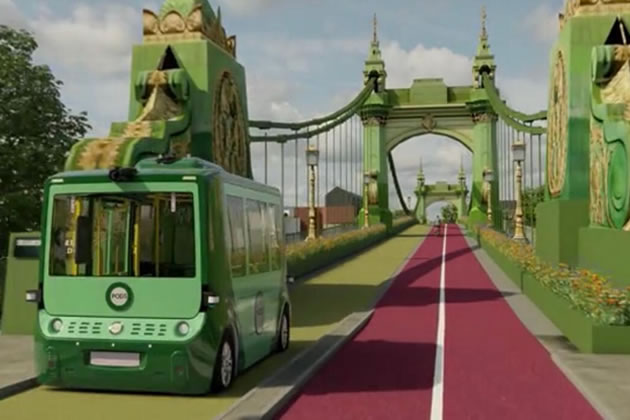
A visualisation of the proposed driverless pods. Picture: BHELT
Previous shuttle proposals are understood to have stalled largely over driver costs — an issue autonomous vehicles sidestep entirely. However, Hammersmith & Fulham's own engineers have cautioned that the shuttles may simply be too heavy for the bridge's current weight restrictions, a limitation that could persist even after the Structures Fund works are completed.
The council must submit its final bid by 3 August, with any funded works required to be complete by 31 March 2030. Importantly, the council — not central government — would be on the hook for any cost overruns on the scheme.
There's cautious optimism that the bid will succeed, not least because the DfT itself is understood to have guided the council toward this scaled-back approach. Should it fail, however, officials warn that a full closure of the bridge — disrupting more than 10,000 daily crossings — looks highly likely.
Looking further ahead, the council has signalled that it intends to spend only the bare statutory minimum from its own funds going forward, leaving it to other parties to find money for anything beyond basic upkeep. Those close to the project believe a second phase of government funding after 2030 could plausibly include provision for motor vehicles, with TfL potentially covering the funding gap between a pedestrian-and-cycle-only bridge and one open to traffic — which may explain the government's preference for framing this as a "phased reopening." Even under this more optimistic scenario, a full reopening remains roughly a decade away — in line with estimates that have circulated for some time.
Like Reading Articles Like This? Help Us Produce More This site remains committed to providing local community news and public interest journalism. Articles such as the one above are integral to what we do. We aim to feature as much as possible on local societies, charities based in the area, fundraising efforts by residents, community-based initiatives and even helping people find missing pets. We’ve always done that and won’t be changing, in fact we’d like to do more. However, the readership that these stories generates is often below that needed to cover the cost of producing them. Our financial resources are limited and the local media environment is intensely competitive so there is a constraint on what we can do. We are therefore asking our readers to consider offering financial support to these efforts. Any money given will help support community and public interest news and the expansion of our coverage in this area. A suggested monthly payment is £8 but we would be grateful for any amount for instance if you think this site offers the equivalent value of a subscription to a daily printed newspaper you may wish to consider £20 per month. If neither of these amounts is suitable for you then contact info@neighbournet.com and we can set up an alternative. All payments are made through a secure web site. One-off donations are also appreciated. Choose The Amount You Wish To Contribute. If you do support us in this way we’d be interested to hear what kind of articles you would like to see more of on the site – send your suggestions to the editor. For businesses we offer the chance to be a corporate sponsor of community content on the site. For £30 plus VAT per month you will be the designated sponsor of at least one article a month with your logo appearing if supplied. If there is a specific community group or initiative you’d like to support we can make sure your sponsorship is featured on related content for a one off payment of £50 plus VAT. All payments are made through a secure web site. |